Volume
Thousands of passengers and crew per sailing, across a fleet with several ships in the water at once. Screening has to run against the manifest as a batch, on a schedule, never as a per-person action at a desk.
In build with a launch customer
Visitor management assumes people arrive one at a time. A voyage does not work that way: a manifest lands weeks out, thousands of names need screening before anyone reaches the terminal, and the ship leaves whether or not the exceptions were resolved.
We're building this now with a cruise operator who has the problem in front of them. What follows is honest about what exists and what is still being designed.
The problem
Three things make embarkation different from a lobby, and each one breaks a tool designed for one person at one door.
Thousands of passengers and crew per sailing, across a fleet with several ships in the water at once. Screening has to run against the manifest as a batch, on a schedule, never as a per-person action at a desk.
A ship sails on the hour it sails. A match found at the terminal is a match found too late. Screening happens weeks out, so an exception still has time to be resolved by a person.
Refusing boarding is a serious act, and so is failing to. Both directions demand a record: what matched, on which list, at what confidence, who reviewed it and what they decided.
In build with a launch customer
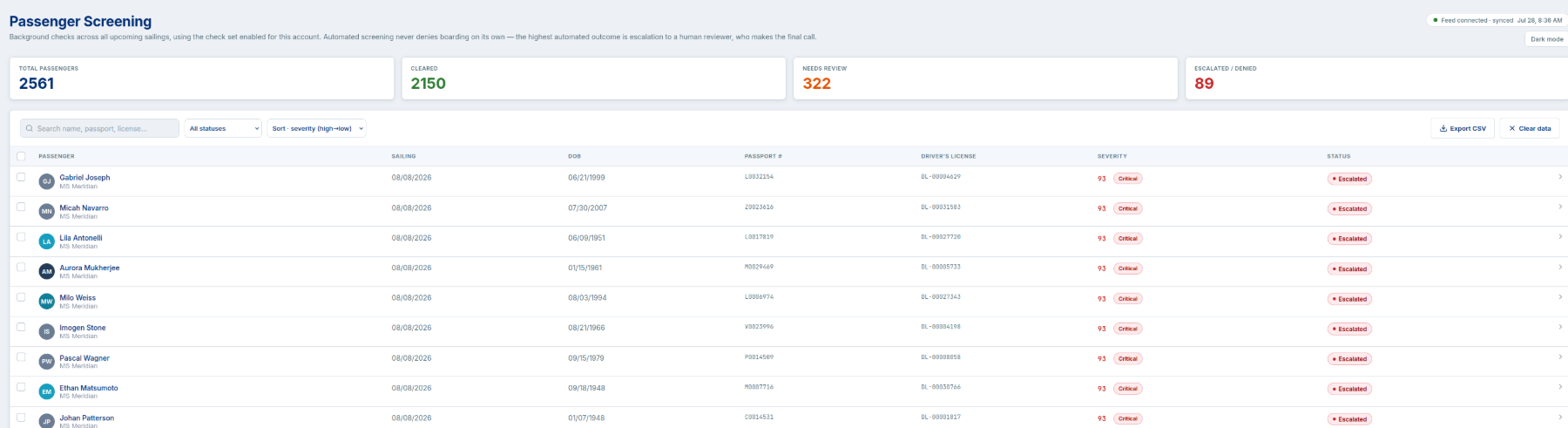
A visitor is one person at one door. A sailing is a manifest: thousands of names arriving at once, on a date that does not move. Upload the manifest or sync the booking feed, and every passenger is screened against the check set you enable, weeks before embarkation.
The queue
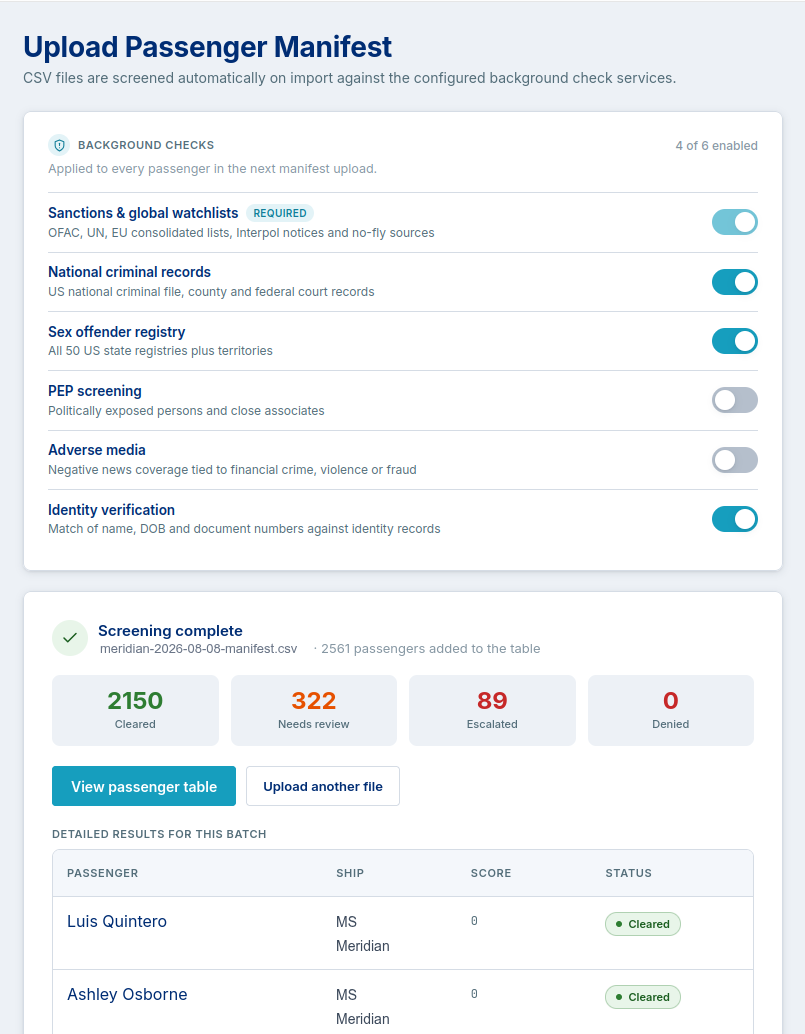
Severity is scored from the match itself, so a phonetic near-miss never sits in the same pile as an exact hit on name, date of birth and document number. Filter, sort, act in bulk where it is safe to, and export the view you are looking at.
Getting the manifest in
Whichever route a passenger arrives by, the same enabled check set runs against them and the results land in the same queue.
The check set
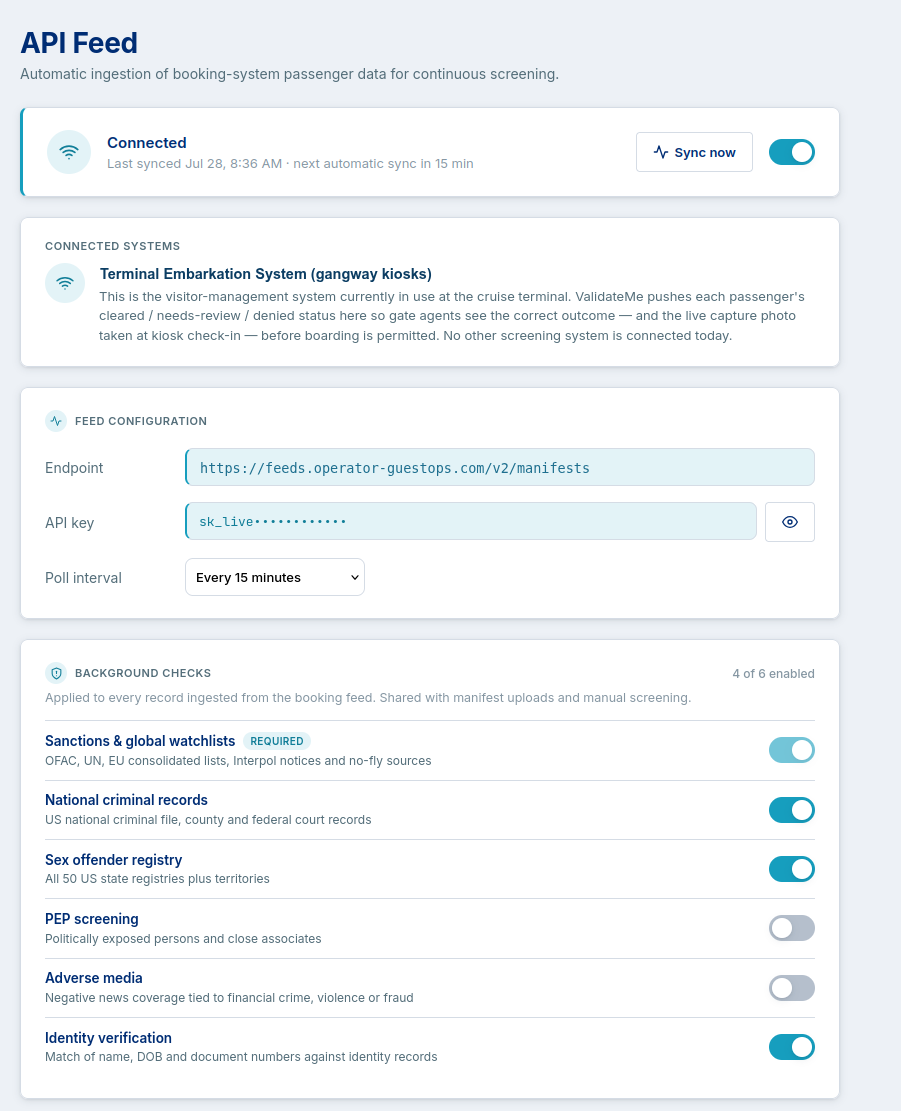
Checks are enabled per account and apply to every passenger ingested afterwards, by upload or by feed. Sanctions screening is mandatory; everything else is a policy decision that belongs to you, not to us.
OFAC, UN and EU consolidated lists, Interpol notices and no-fly sources.
National criminal file, county and federal court records.
State registries and territories, consolidated.
Politically exposed persons and close associates.
Negative news tied to financial crime, violence or fraud.
Name, date of birth and document numbers against identity records.
Adjudication
Every match carries the source, the list it came from, the name it matched, a confidence score and a note explaining the basis. A reviewer sees why something surfaced before choosing what to do about it.
This is the part we will not compromise on. Automated screening produces evidence, not verdicts. The highest state it can reach on its own is Escalated, and a human being is required to go further.
Beyond the passenger
A cruise operation runs shoreside offices, terminals, dry docks and crew rotations. The platform that screens passengers is already the platform that manages the rest.
Handling the data
Passenger names, dates of birth and document numbers, matched against criminal and sanctions sources. It is treated accordingly.
How we build
Everything on this page traces back to an operator describing what actually breaks. If you run a cruise, port or shipyard operation and your version of the problem is different, that difference is the useful part of the conversation. We would rather hear it now, while the design is still moving.
Cruise & maritime
Spreadsheets included. We'll show you the screening pipeline against your own structure, and be straight about what is built and what we'd build for you.